
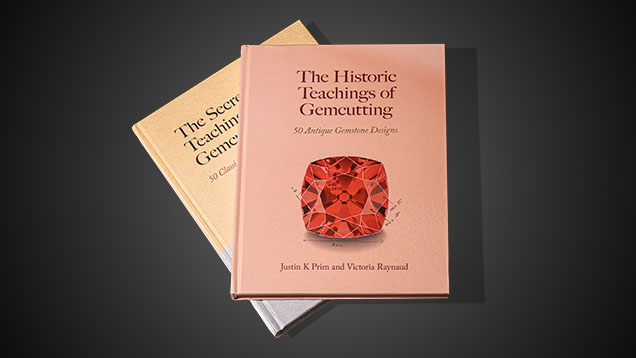
In the niche field of lapidary literature, high-quality publications devoted specifically to gemstone faceting remain relatively uncommon. In 2021, Justin K. Prim addressed this gap with The Secret Teachings of Gemcutting: 50 Classic Gemstone Designs, a work that focused on practical design execution and introduced many cutters to historically inspired approaches outside of standard meetpoint faceting. Now, with The Historic Teachings of Gemcutting: 50 Antique Gemstone Designs, Prim—joined by coauthor Victoria Raynaud—has produced a compelling companion volume that expands not only on design but also on the broader historical context of the craft.
Readers familiar with Prim’s earlier work will immediately recognize the layout, functionality, and overall structure of this second volume. The book maintains the same clean, highly organized format and approachable presentation style that made The Secret Teachings of Gemcutting so effective as a reference tool at the faceting machine. However, this new installment goes a step further by placing a stronger emphasis on the historical development of gemstone cutting traditions across the globe.
The authors present a thoughtfully researched overview of lapidary history, tracing the evolution of cutting styles from early step cuts to more complex mixed-cut designs. Along the way, they explore advancements in polishing techniques, the refinement of symmetry and proportions, and the gradual development of faceting diagrams as we know them today. This historical narrative is one of the book’s strongest contributions, offering readers valuable insight into how and why certain cutting styles emerged and how they continue to influence modern gem design. While a significant amount of research underpins this section, the material is presented in an accessible and digestible format that will appeal to both hobbyists and experienced professionals.
As with the first volume, the core component of the book features 50 faceting designs. These antique-inspired patterns serve as an excellent complement to the 50 classic designs presented in Prim’s earlier publication, effectively broadening the cutter’s repertoire. The designs retain the characteristic aesthetic associated with historic cutting styles, emphasizing curved girdles, subtle proportions, and optical effects that differ from the precision-driven meetpoint approach familiar to many modern faceters.
One notable enhancement in this volume is the introduction of color-coded faceting diagrams for select designs. This addition significantly improves clarity by visually linking each facet in the diagram to its corresponding cutting instructions. For cutters working through unfamiliar or nonstandard sequences, this feature provides a welcome level of guidance and helps reduce ambiguity during the cutting process. It represents a thoughtful evolution of the instructional format and demonstrates the authors’ attention to usability.
With Raynaud joining as coauthor, the book benefits from a seamless collaboration that preserves the visual clarity and ease of use established in the first volume, while deepening the scholarly and historical scope. The illustrations remain clean, precise, and easy to follow, reinforcing the book’s function as both an instructional guide and a design reference.
Overall, The Historic Teachings of Gemcutting succeeds as both a companion and a substantial expansion of Prim’s earlier work. It combines practical faceting instruction with a well-developed historical narrative, offering readers a more complete understanding of gemstone cutting as both a technical discipline and an evolving art form. The inclusion of new diagrammatic features and the addition of Raynaud’s technical gemcutting contributions further enhance its value.
Together with The Secret Teachings of Gemcutting, this volume forms a highly complementary set that will appeal to a wide range of gemcutters. The authors have produced a carefully executed and thoughtfully designed work that deserves a place in the library of any serious lapidary enthusiast. Copies of the book at the time of this review are available for order at www.magusgems.com.
Nathan Renfro is senior manager of colored stone identification at GIA in Carlsbad, California.
In the niche field of lapidary literature, high-quality publications devoted specifically to gemstone faceting remain relatively uncommon. In 2021, Justin K. Prim addressed this gap with The Secret Teachings of Gemcutting: 50 Classic Gemstone Designs, a work that focused on practical design execution and introduced many cutters to historically inspired approaches outside of standard meetpoint faceting. Now, with The Historic Teachings of Gemcutting: 50 Antique Gemstone Designs, Prim—joined by coauthor Victoria Raynaud—has produced a compelling companion volume that expands not only on design but also on the broader historical context of the craft.
Readers familiar with Prim’s earlier work will immediately recognize the layout, functionality, and overall structure of this second volume. The book maintains the same clean, highly organized format and approachable presentation style that made The Secret Teachings of Gemcutting so effective as a reference tool at the faceting machine. However, this new installment goes a step further by placing a stronger emphasis on the historical development of gemstone cutting traditions across the globe.
The authors present a thoughtfully researched overview of lapidary history, tracing the evolution of cutting styles from early step cuts to more complex mixed-cut designs. Along the way, they explore advancements in polishing techniques, the refinement of symmetry and proportions, and the gradual development of faceting diagrams as we know them today. This historical narrative is one of the book’s strongest contributions, offering readers valuable insight into how and why certain cutting styles emerged and how they continue to influence modern gem design. While a significant amount of research underpins this section, the material is presented in an accessible and digestible format that will appeal to both hobbyists and experienced professionals.
As with the first volume, the core component of the book features 50 faceting designs. These antique-inspired patterns serve as an excellent complement to the 50 classic designs presented in Prim’s earlier publication, effectively broadening the cutter’s repertoire. The designs retain the characteristic aesthetic associated with historic cutting styles, emphasizing curved girdles, subtle proportions, and optical effects that differ from the precision-driven meetpoint approach familiar to many modern faceters.
One notable enhancement in this volume is the introduction of color-coded faceting diagrams for select designs. This addition significantly improves clarity by visually linking each facet in the diagram to its corresponding cutting instructions. For cutters working through unfamiliar or nonstandard sequences, this feature provides a welcome level of guidance and helps reduce ambiguity during the cutting process. It represents a thoughtful evolution of the instructional format and demonstrates the authors’ attention to usability.
With Raynaud joining as coauthor, the book benefits from a seamless collaboration that preserves the visual clarity and ease of use established in the first volume, while deepening the scholarly and historical scope. The illustrations remain clean, precise, and easy to follow, reinforcing the book’s function as both an instructional guide and a design reference.
Overall, The Historic Teachings of Gemcutting succeeds as both a companion and a substantial expansion of Prim’s earlier work. It combines practical faceting instruction with a well-developed historical narrative, offering readers a more complete understanding of gemstone cutting as both a technical discipline and an evolving art form. The inclusion of new diagrammatic features and the addition of Raynaud’s technical gemcutting contributions further enhance its value.
Together with The Secret Teachings of Gemcutting, this volume forms a highly complementary set that will appeal to a wide range of gemcutters. The authors have produced a carefully executed and thoughtfully designed work that deserves a place in the library of any serious lapidary enthusiast. Copies of the book at the time of this review are available for order at www.magusgems.com.
Nathan Renfro is senior manager of colored stone identification at GIA in Carlsbad, California.