We have read with great interest the Winter 2021 article entitled “Blue sapphires from Mogok, Myanmar: A gemological review,” by Wasura Soonthorntantikul et al. (pp. 292–317). The authors conducted a fairly complete bibliographical review and a qualitative characterization using gemological, spectroscopic, and chemical techniques, improving our knowledge of Mogok’s rare and renowned blue sapphires. In the process, the authors associate the 640 nm emission band of orange luminescence with “trapped hole chromophores,” quoting Hughes et al. (2017), that section of the book being based on Segura’s gemology dissertation at the University of Nantes (Segura, 2013). We wish to add further details regarding orange luminescence in corundum, from Mogok and elsewhere. In particular, we recently conducted a rather extensive study of this luminescence, making it possible to describe in further detail the defect(s) involved.
Dr. Soonthorntantikul and her associates state that “the remainder displayed zoned orange fluorescence (with very weak or no red fluorescence) in near-colorless to light blue color zones,” as seen in their figure 12. For Mogok, orange luminescence has also been described in the yellow zone of a blue sapphire (Ho et al., 2018, pp. 128–129). Actually, for all sapphires worldwide, orange luminescence is absent from blue zones and may be found only in near-colorless or yellow domains. This behavior can be explained for all corundum. Indeed, the blue color is related to the Fe-Ti charge transfer, and thus blue zones contain iron, also as Fe3+, as can be seen in their UV-visible absorption spectrum (see figure 26 of Soonthorntantikul et al.). In blue zones, the O2–-Fe3+ charge transfer absorbs the ultraviolet range, taking away the source of energy necessary to induce luminescence. Thus, it acts as a luminescence quencher for orange and red emissions.
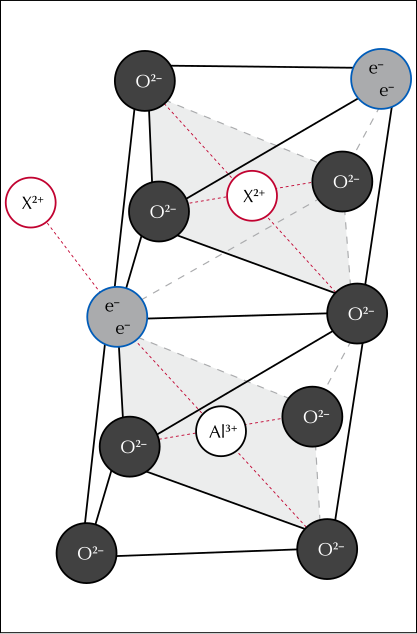
Regarding the nature of the defect involved with orange fluorescence, the locution “trapped hole chromophore” does not describe the atomic structure in which the hole is trapped. Our team proposes a more complete description deduced from the careful characterization of a collection of nearly 100 orange-luminescing corundum (Vigier et al., 2021a,b). Based on luminescence excitation spectra and other arguments, the orange luminescence has been related to a color center or defect including two oxygen vacancies. An oxygen vacancy is a missing oxygen atom in the lattice (see above), which can be created by chemical means during growth or induced by irradiation after growth, for example. Such a defect is called an F-center, or even VO°° (Kröger-Vink notation) in the physics community. An oxygen vacancy may contain zero, one, or two unpaired electrons. Thus, when there are two vacancies from two oxygens, each containing two electrons, four electrons are electrically compensated in the corundum structure by the presence of two divalent cations (see also Emmett et al., 2003). This double defect is an F2 center, compensated by two divalent ions such as Mg2+, Be2+, and rarely Mn2+ (again, see above). The concentration of such defects is not known but may be very small (of the order of parts per million or less), as luminescence is a very efficient way to detect defects. The chemical results presented in Soonthorntantikul et al. (2021) explicit that there are always traces of magnesium, which is consistent with this proposed structure.
Furthermore, concerning the relation between orange luminescence and infrared absorption, the authors state: “We noted that the studied sapphires exhibiting the 3161 cm–1 IR feature frequently show orange zoned fluorescence…” This is true for Mogok samples and—in our experience—for some metamorphic yellow sapphires (generally from Sri Lanka). However, for other corundum (natural, synthetic, or treated), we did not note any correlation of the 3161 cm–1 band with orange luminescence.
We hope these additional scientific details will be helpful to better understand the little-studied orange luminescence in sapphire and will nicely complement the work of Dr. Soonthorntantikul and her colleagues.
Maxence Vigier and Emmanuel Fritsch
University of Nantes
CNRS, Institut des Matériaux Jean Rouxel, IMN
Nantes, France
REPLY
We truly appreciate the letter from Maxence Vigier and Dr. Emmanuel Fritsch for the detailed information on defects for orange luminescence in corundum and also for sharing their experience with this feature. Their letter is very helpful and improved our knowledge on this luminescence. We noted the feature in a few samples but did not further explore this, since it would have taken us outside the scope of the article.
Wasura Soonthorntantikul, Ungkhana Atikarnsakul, and Wim Vertriest
GIA, Bangkok
Emmett J.L., Scarratt K., McClure S.F., Moses T., Douthit T.R., Hughes R., Novak S., Shigley J.E., Wang W., Bordelon O., Kane R.E. (2003) Beryllium diffusion of ruby and sapphire. G&G, Vol. 39, No. 2, pp. 84–135, http://dx.doi.org/10.5741/GEMS.39.2.84
Ho K., Fritsch E., Rabouan J.-B., Notari F., Caplan C., Hainschwang T. (2018) Mogok: The Valley of Precious Stones. Glénat Livres, Grenoble, 191 pp.
Hughes R.W., Manorotkul W., Hughes E.B. (2017) Ruby & Sapphire: A Gemologist’s Guide. RWH Publishing, 732 pp.
Segura O. (2013) La luminescence orange des corindons. Diplôme universitaire de gemmologie, Université de Nantes, 60 pp.
Soonthorntantikul W., Atikarnsakul U., Vertriest W. (2021) Blue sapphires from Mogok, Myanmar: A gemological review. G&G, Vol. 57, No. 4, pp. 292–317, http://dx.doi.org/10.5741/GEMS.57.4.292
Vigier M., Fritsch E., Segura O. (2021a) Orange luminescence of corundum, an atypical origin for gemmologists (part one) [in French with English abstract and figure captions]. Revue de l’Association Francaise de Gemmologie, Vol. 211, pp. 12–19.
——— (2021b) Orange luminescence of corundum, an atypical origin for gemmologists (part two) [in French with English abstract and figure captions]. Revue de l’Association Francaise de Gemmologie, Vol. 212, pp. 12–18.
We have read with great interest the Winter 2021 article entitled “Blue sapphires from Mogok, Myanmar: A gemological review,” by Wasura Soonthorntantikul et al. (pp. 292–317). The authors conducted a fairly complete bibliographical review and a qualitative characterization using gemological, spectroscopic, and chemical techniques, improving our knowledge of Mogok’s rare and renowned blue sapphires. In the process, the authors associate the 640 nm emission band of orange luminescence with “trapped hole chromophores,” quoting Hughes et al. (2017), that section of the book being based on Segura’s gemology dissertation at the University of Nantes (Segura, 2013). We wish to add further details regarding orange luminescence in corundum, from Mogok and elsewhere. In particular, we recently conducted a rather extensive study of this luminescence, making it possible to describe in further detail the defect(s) involved.
Dr. Soonthorntantikul and her associates state that “the remainder displayed zoned orange fluorescence (with very weak or no red fluorescence) in near-colorless to light blue color zones,” as seen in their figure 12. For Mogok, orange luminescence has also been described in the yellow zone of a blue sapphire (Ho et al., 2018, pp. 128–129). Actually, for all sapphires worldwide, orange luminescence is absent from blue zones and may be found only in near-colorless or yellow domains. This behavior can be explained for all corundum. Indeed, the blue color is related to the Fe-Ti charge transfer, and thus blue zones contain iron, also as Fe3+, as can be seen in their UV-visible absorption spectrum (see figure 26 of Soonthorntantikul et al.). In blue zones, the O2–-Fe3+ charge transfer absorbs the ultraviolet range, taking away the source of energy necessary to induce luminescence. Thus, it acts as a luminescence quencher for orange and red emissions.
Regarding the nature of the defect involved with orange fluorescence, the locution “trapped hole chromophore” does not describe the atomic structure in which the hole is trapped. Our team proposes a more complete description deduced from the careful characterization of a collection of nearly 100 orange-luminescing corundum (Vigier et al., 2021a,b). Based on luminescence excitation spectra and other arguments, the orange luminescence has been related to a color center or defect including two oxygen vacancies. An oxygen vacancy is a missing oxygen atom in the lattice (see above), which can be created by chemical means during growth or induced by irradiation after growth, for example. Such a defect is called an F-center, or even VO°° (Kröger-Vink notation) in the physics community. An oxygen vacancy may contain zero, one, or two unpaired electrons. Thus, when there are two vacancies from two oxygens, each containing two electrons, four electrons are electrically compensated in the corundum structure by the presence of two divalent cations (see also Emmett et al., 2003). This double defect is an F2 center, compensated by two divalent ions such as Mg2+, Be2+, and rarely Mn2+ (again, see above). The concentration of such defects is not known but may be very small (of the order of parts per million or less), as luminescence is a very efficient way to detect defects. The chemical results presented in Soonthorntantikul et al. (2021) explicit that there are always traces of magnesium, which is consistent with this proposed structure.
Furthermore, concerning the relation between orange luminescence and infrared absorption, the authors state: “We noted that the studied sapphires exhibiting the 3161 cm–1 IR feature frequently show orange zoned fluorescence…” This is true for Mogok samples and—in our experience—for some metamorphic yellow sapphires (generally from Sri Lanka). However, for other corundum (natural, synthetic, or treated), we did not note any correlation of the 3161 cm–1 band with orange luminescence.
We hope these additional scientific details will be helpful to better understand the little-studied orange luminescence in sapphire and will nicely complement the work of Dr. Soonthorntantikul and her colleagues.
Maxence Vigier and Emmanuel Fritsch
University of Nantes
CNRS, Institut des Matériaux Jean Rouxel, IMN
Nantes, France
REPLY
We truly appreciate the letter from Maxence Vigier and Dr. Emmanuel Fritsch for the detailed information on defects for orange luminescence in corundum and also for sharing their experience with this feature. Their letter is very helpful and improved our knowledge on this luminescence. We noted the feature in a few samples but did not further explore this, since it would have taken us outside the scope of the article.
Wasura Soonthorntantikul, Ungkhana Atikarnsakul, and Wim Vertriest
GIA, Bangkok
Emmett J.L., Scarratt K., McClure S.F., Moses T., Douthit T.R., Hughes R., Novak S., Shigley J.E., Wang W., Bordelon O., Kane R.E. (2003) Beryllium diffusion of ruby and sapphire. G&G, Vol. 39, No. 2, pp. 84–135, http://dx.doi.org/10.5741/GEMS.39.2.84
Ho K., Fritsch E., Rabouan J.-B., Notari F., Caplan C., Hainschwang T. (2018) Mogok: The Valley of Precious Stones. Glénat Livres, Grenoble, 191 pp.
Hughes R.W., Manorotkul W., Hughes E.B. (2017) Ruby & Sapphire: A Gemologist’s Guide. RWH Publishing, 732 pp.
Segura O. (2013) La luminescence orange des corindons. Diplôme universitaire de gemmologie, Université de Nantes, 60 pp.
Soonthorntantikul W., Atikarnsakul U., Vertriest W. (2021) Blue sapphires from Mogok, Myanmar: A gemological review. G&G, Vol. 57, No. 4, pp. 292–317, http://dx.doi.org/10.5741/GEMS.57.4.292
Vigier M., Fritsch E., Segura O. (2021a) Orange luminescence of corundum, an atypical origin for gemmologists (part one) [in French with English abstract and figure captions]. Revue de l’Association Francaise de Gemmologie, Vol. 211, pp. 12–19.
——— (2021b) Orange luminescence of corundum, an atypical origin for gemmologists (part two) [in French with English abstract and figure captions]. Revue de l’Association Francaise de Gemmologie, Vol. 212, pp. 12–18.