
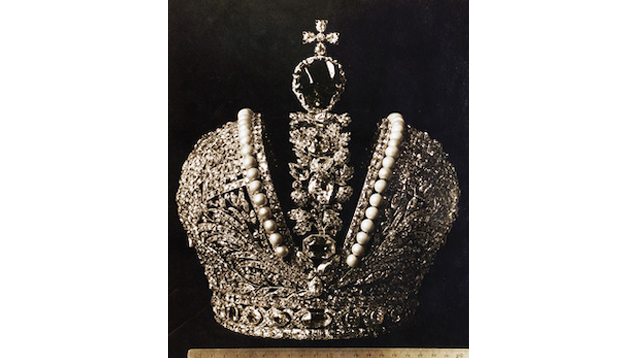
With its fiery red appearance, the ruby variety of corundum has been sought after and cherished as a gemstone since ancient times. The most valuable rubies came from mines in the Mogok region of Burma (Myanmar), while others originated from India, Ceylon (Sri Lanka), and the border region between Thailand and Cambodia. Ruby is aluminum oxide colored by a small amount of chromium.
Spinel is a different mineral – magnesium aluminum oxide – that can also display a red color due to chromium. Both minerals exhibit a hardness that allows them to be used as polished gems. Spinel originated from most of the same countries mentioned above, as well as areas of Afghanistan and Tajikistan.
For a thousand years or more, red or rose-red gem spinels from Central Asia were traditionally but somewhat incorrectly referred to as “Balas rubies”, a name that is thought to have been derived from town of Balkh (Bactria) in the Badakhshan region of Afghanistan. The crystals of both minerals have different shapes, but when found as rounded, water-worn fragments in alluvial gem deposits they could appear similar. Spinel crystals can be larger in size than those of most rubies. The two minerals exhibit different physical and optical properties, but their similar appearance meant that sometimes they were confused with one another. As a result, some well-known historical “rubies” were actually red spinels.
It was not until 1783 that the scientific distinction between these two minerals was established by Jean-Baptiste Louis Romé de l’Isle from his study of their crystal shapes. Earlier, in 1669, Nicolas Steno had discovered what is called the “law of constancy of angles” between the flat faces of quartz crystals regardless of their size. By applying that observation to the study of crystals of other minerals and using a contact goniometer (designed and constructed by Arnould Carangeot), Romé de l’Isle accurately measured the interfacial angles of a great variety of crystals. With this simple instrument, he was able to determine that corundum and spinel were distinct minerals because of their differing crystal forms.
Located less than 1 mile from the Pyandzh River which forms the boundary between Tajikistan and Afghanistan, one of the most important spinel deposits is the occurrence near the remote village of Kukh-i-lal in the Pamir Mountains. Intermittent mining in this area for over a thousand years has produced many of the large, magnificent red and reddish pink spinels that are represented in the historical crown jewels of various countries. The Tajikistan mines were rediscovered near the end of the 1800s, and over the next century were subsequently visited by geologists. Spinels in several colors are found in metamorphic marbles in association with forsterite (peridot) and clinohumite.
How to Use this Reading List
This reading list gives you an opportunity to learn more about the history of ruby and red spinel. Entries in the list are presented in chronological order to emphasize the development of ideas over time. The list is not comprehensive, but is a compilation of some interesting information that has often been forgotten or overlooked.
Many of the articles in the reading list exist in the public domain and can be found online at digital libraries such as Hathitrust, Internet Archive, or other digital repositories. More recent publications can often be found in libraries. Abstracts of these more recent articles can usually be found on the website of the original journal or magazine, and the article itself is often available for purchase from the publisher.
Chemische Untersuchung des Rubins [Chemical Study of Rubies], M.H. Klaproth, Schriften der Gesellschaft Naturforschender Freunde zu Berlin, Vol. 9, pp. 336-350, (1789). Early chemical analysis of ruby and “ruby spinel”.
Untersuchung des Spinells [Examination of Spinels], M.H. Klaproth, Beiträge zur Chemischen Kenntnis der Mineralkörper, Vol. 2, pp. 1-11, (1797). Chemical study of various colors of spinel including red spinel. This article was also published in 1799 in both the Journal of Natural Philosophy, Chemistry and the Arts, Vol. 3, (November), pp. 349-353 and Annales de Chimie, Vol. 31, pp. 141-153. The author discusses the range of spinel colors and the past confusion of their mineral identity and variety names. Chemical analysis revealed the presence of magnesium in spinel that clearly distinguishes it from corundum.
Du Rubis Spinelle [Ruby Spinel], L.N. Vauquelin, Journal des Mines, Vol. 7, No. 38, pp. 81-92, (1797). An early chemical analysis study of ruby spinel. The article was also published in the Annales de Chimie et de Physique, Vol. 26, pp. 3-18, (1798).
Chemische Untersuchung des Spinells, und der Minerale von Analoger Zusammensetzung [Chemical Study of Spinel and Minerals of Analogous Composition], H. Abich, Annalen der Physik und Chemie, Vol. 99, No. 3, pp. 305-355, (1831). Early chemical analyses of various spinels and related minerals.
Oriental Accounts of the Precious Minerals, J. Prinsep and R. Kalíkishen, Journal of the Asiatic Society of Bengal, Vol. 1, No. 8, pp. 353-363, (1832). The authors discuss some historical Asian accounts of several gemstones including ruby and ruby spinel.
“The Travels of Marco Polo, Greatly Amended and Enlarged”, Hugh Murray, Oliver and Boyd Publishers, Edinburgh, 368 pp. (1845). Between 1271 and 1295 the famous Venetian merchant and explorer traveled through Asia along the Silk Road until he eventually reached China. This book contains a short description on pages 233-234 of the gem mines in the region of Badakhshan, including those that produced balas ruby (red spinel). A similar account can be found on pages 149-150 in “The Book of Ser Marco Polo, the Venetian, Concerning the Kingdoms and Marvels of the East”, H. Yule, Vol. 1, J. Murray Publishers, London, 409 pp. (1871).
The great Balas Ruby - A Tale of the Reign of Edward the Third, H. Laurance, The Casquet of Literature, Vol. 3, pp. 40-49, (1874) edited by Charles Gibbon. A romantic story of King Edward the Third and the ruby spinel used in his crown.
“Stories about Famous Precious Stones”, A.E. Orpen, D. Lothrop Publishers, Boston, 286 pp., (1890). This book contains a chapter on the Black Prince’s ruby (spinel).
Les Enclaves du Saphir, du Rubis et du Spinelle [The Inclusions in Sapphire, Ruby, and Spinel], W. Prinz, Bulletin de la Société Belge de Microscopie, Vol. 8, pp. 97-105, (1882). An early discussion of solid and fluid inclusions in several gem minerals as seen with a microscope, with illustrations of some of these inclusions.
A Description of Two Large Spinel Rubies, with Persian Characters Engraved upon Them, V. Ball, Proceedings of the Royal Irish Academy, Vol. 3, pp. 380-400 (1894). The author describes the two engraved red spinels, and he discusses the historical use of “Balas rubies” that, along with large diamonds, were often given as gifts among Asian rulers. The text is accompanied by illustrations of the rubies and their engraved characters. This article was reprinted in the Gemmological Digest, Vol. 3, No. 1, pp. 57-68, (1990).
Sur la Double Réfraction Accidentelle des Cristaux Cubiques [On Anomalous Double Refraction of Cubic Crystals], P. Gaubert, Bulletin du Muséum d'Histoire Naturelle, Vol. 8, pp. 481-484, (1902). The author discusses the observation of anomalous double refraction in several optically isotropic crystals with cubic symmetry including ruby spinel.
Absorption und Lichtbrechung der Roten, Blauen und Violetten Spinelle von Ceylon [Light Absorption and Refraction of Red, Blue and Violet Spinels from Cerylon], K. Schlossmacher, Zeitschrift für Kristallographie, Mineralogie und Petrographie, Vol. 72, No. 5/6, pp. 447-475, (1930) and Die Farbgebende Substanz der Natürlichen Roten, Blauen, Braunen und Violetten Spinelle von Ceylon [The Coloring Substances of Red, Blue, Brown and Violet Spinels from Cerylon], Zeitschrift für Kristallographie, Mineralogie und Petrographie, Vol. 76, No. 5, pp. 377-385, (1931). Two studies by the same author of the optical properties and causes of color in spinels from Sri Lanka.
The Geology and Gemstones of the Mogok Stone Tract, Burma, L.A.N. Iyer, Memoirs of the Geological Survey of India, Vol. 82, pp. 8-100, (1953). This memoir provides a detailed geological description of the Mogok Stone Tract and its gem minerals.
The Absorption Spectrum of Chromium in the Spinel Structure, R.A. Ford and O.F. Hill, Spectrochimica Acta, Vol. 16, No. 11/12, pp. 1318-1321, (1960). When present in the spinel structure, chromium produces absorption features that in turn give rise to the red color.
Spinel-Forsterite Formations in Magnesite Marbles from the Kukhilal Deposit of Noble Spinel (in Russian), L.N. Rossovskii and L.S. Zilberfarb, Materialy po Geologii Pamira, No. 1, pp. 274-291, (1963). Article not seen.
Relation of Optical Properties of Natural Chrome-Spinels to their Composition (in Russian), A.D. Rakcheev and T.A. Sminova, Geologiia Rudnykh Mestorozhdenii, Vol 14, No. 1, pp. 31-51, (1972). Article not seen.
Detection of Structural Varieties of Red Gem Spinels from Ratnapura, Sabaragamuwa Province of Sri Lanka, A.A.F. Lagerway, Scripta Geologica, Vol. 27, No. 1, pp. 1-27, (1974). A study of the luminescence spectroscopy of red spinels due to the presence of chromium.
The Color of Gem Spinels from Deposit Kukhilal (in Russian), V.V. Bukanov, A.N. Platonov and M.N. Taran, Proceedings of the Russian Mineralogical Society, Vol. 106, No. 5, pp. 565-571, (1977). A study of the absorption spectra and coloration of spinels from the famous deposit in Tajikistan.
Early Mining and Marketing of the Balas Ruby, together with some Curious and Other Views concerning the Properties of the Mineral, K.F.G. Hosking, Warta Geologi, Vol. 5, No. 1, pp. 7-8, (1979). A brief note on Marco Polo’s visit to Badakhshan, and of the high regard held by local rulers at the time in Badakhshan for Balas rubies.
Stages of Mineral Origin in the Magnesian Skarns of the Kuhi-lal Deposit (South-Western Pamirs) (in Russian), V.I. Kislev, Doklady Akademii Nauk Respubliki Tajikistan, Vol. 22, No. 7, pp. 433-438, (1979). Article not seen.
Gemstones of Pakistan: Emerald, Ruby and Spinel, E.J. Gübelin, Gems & Gemology, Vol. 18, No. 3, pp. 123-129, (1982). A description of a region in northern Pakistan that has historically been a source of red spinel and ruby.
Pamir Spinel: A New Russian Gem, P. Bancroft, Jewelers’ Circular Keystone Magazine, Vol. 160, No. 12, pp. 522-523, (1989). A short article on gem spinels from the Kukh-i-lal deposit in the Pamir Mountains of Tajikistan.
Colour of Natural Spinels, Gahnospinels and Gahnites, K. Schmetzer, C. Haxel and G. Amthauer, Neues Jahrbuch für Mineralogie Abhandlungen, Vol. 160, No. 2, pp. 159-180, (1988). The authors review the causes of color in a wide variety of gem spinels. The mineral is colorless when chemically pure, but the presence of small amounts of so-called transition metals (such as chromium, iron, vanadium, manganese, and to a lesser extent zinc and cobalt) give spinels their range of colors. Red (chromium) and blue (cobalt) spinels are the most highly valued.
Centros de Color en Espinelas [Color Centers in Spinels], J.S. Cozar and A. Ibarra, Boletín del Instituto Gemológico Español, Vol. 34, pp. 42-52, (1992). The authors review the causes of color in various spinels.
The Myth of the Timur Ruby, S. Stronge, Jewellery Studies, Vol. 7, pp. 5-12, (1996). Discussion of a rough polished, engraved, 352.54 ct red spinel that is currently part of the British Crown Jewels.
The Role of the Modifying Chromium Ion in the Structure of Magnesian Spinel, V.P. Krokhin, V.S. Bessmertnyi, O.V. Puchka and A.D. Kirienko, Glass and Ceramics, Vol. 55, No. 9/10, pp. 278-282, (1998). The authors discuss the occurrence of chromium cations in the spinel structure and their role in spinel coloration.
The Red Stones of Light in Iranian Culture, I: Spinels, A.S. Melikian-Chirvani, Bulletin of the Asia Institute, Vol. 15, pp. 77-110, (2001). Among the red gemstones admired because they evoked the light of dusk, spinels as well as rubies were both sought after and celebrated in Iranian literature, from Persian poetry and historical chronicles to gemological books written in Arabic or Persian. The connection of precious stones with light and divinity also had important symbolic meaning in Islam and other religions in historical Persia.
Balas Rubies for the King of England (1413-1415), M.P. Pedani, Electronic Journal of Oriental Studies, Vol. 5, No. 7, pp. 1-13, (2002). Article not seen.
Genetic Position of Precious Spinels in Magnesium Skarns of the South-West Pamirs (in Russian), A.K. Litvinenko, Proceedings of the Russian Mineralogical Society, Vol. 132, No. 1, pp. 76-82, (2003). Article not seen.
Nuristan - South Pamir Province of Precambrian Gems, A.K. Litvinenko, Geology of Ore Deposits, Vol. 46, No. 4, pp. 263-268, (2004). Article not seen.
Study on Physical Properties and Chemical Composition of Some Myanmar Gems, M.H. Kyaw, K. Tun and H. Sein, Journal of Myanmar Academy of Arts and Sciences, Vol. 2, No. 2, pp. 173-178, (2004). A study of the gemological and other properties of various gem minerals Myanmar including spinel.
The Forms of Kukhilal (Tajikistan) Noble Spinel Crystals and its Genetic Significance (in Russian), A.R. Fayziev, Proceedings of the Russian Mineralogical Society, Vol. 136, pp. 363-365, (2007). The author describes the crystal morphology of spinel crystals from this deposit.
A Closer Look at Vietnamese Spinel, C.P. Smith and C.R. Beasley, InColor Magazine, Spring, pp. 11-13, (2008). A brief review of the gemological properties of Vietnamese spinel.
Spinel: Resurrection of a Classic, V. Pardieu and R.W. Hughes, InColor Magazine, Summer, pp. 10-18, (2008). A discussion of the increasing importance of spinel in the marketplace.
Morphological and Gemmological Features of Gem-Quality Spinel from the Goron Deposit, Southwestern Pamirs, Tajikistan, S.A. Ananyev and S.I. Konovalenko, Journal of Gemmology, Vol. 33, No. 1/4, pp. 15-18, (2012). A short description of a new locality that produces pink spinel.
Spinel and Its Treatments: A Current Status Report, C.P. Smith, InColor Magazine, Spring, pp. 50-54, (2012). A review of the clarity and color treatments used for spinels.
Orangey-Red to Orangey-Pink Gem Spinels from a New Deposit at Lang Chap (Tan Huong - Truc Lau), Vietnam, A.K. Malsy, S. Karampelas, D. Schwarz, L. Klemm, T. Armbruster and D.A Tuan, Journal of Gemmology, Vol. 33, No. 1/4, pp. 19-27, (2012). A study of gem spinels from a locality in Vietnam.
Investigating the Colour of Spinel: 1. Red Gem-Quality Spinels ("Balas") from Ratnapura (Sri Lanka), A. Gorghinian, A. Mottana, A. Rossi, F.M. Oltean, A. Esposito and A. Marcelli, Rendiconti Lincei, Scienze Fisiche e Naturali, Vol. 24, No. 4, pp. 127-140, (2013). A study of the cause of red coloration in balas spinels from Sri Lanka.
Voyage du Cercle de l'Octaëdre en Birmanie [Travel of the Circle of Octahedra in Burma], C. Chancerel and E. Pavillon, Revue de Gemmologie, No. 188, pp. 29-32, (2014). A trip report to visit spinel localities in Burma.
Hunting for "Jedi" Spinels in Mogok, V. Pardieu, Gems & Gemology, Vol. 50, No. 1, pp. 46-57, (2014). One of the first studies of intense red spinels from Mogok in Myanmar.
Hope, Hertz and a Red Spinel, J. Ogden, Gems and Jewellery, Vol. 24, No. 6, pp. 20-21, (2015). A short note on a 50.13 ct gem spinel thought to be from Tajikistan that was in the collection of Henry Philip Hope (1774-1839), a wealthy London merchant and banker who was a prominent patron of the arts. The 1839 catalogue of his gem collection also mentions a 45.52 ct blue diamond that would become known as the Hope Diamond.
World of Magnificent Spinels: Provenance and Identification, A. Peretti, A. Kanpraphai-Peretti and D. Günther, Contributions to Gemology, No. 11, pp. 1-293, (2015). A detailed study of spinels in terms of their identification, sources, and treatment.
Effect of Heat Treatment on Red Gemstone Spinel: Single Crystal X-ray, Raman and Photoluminescence Study, R. Widmer, A.-K. Malsy and T. Armbruster, Physics and Chemistry of Minerals, Vol. 42, No. 4, pp. 251-260, (2015). Study of the effects of heat treatment from 600 to 1100°C of a red spinel from Myanmar on its crystal structure and spectroscopy.
“Ruby, Sapphire and Spinel: An Archaeological, Textural and Cultural Study”, D.J. Content, 2 volumes, 480 pp., Brepols Publishers, Turnhout, Belgium, (2016). This two-volume scholarly work focuses on the historical use and nomenclature of these three important colored gemstones.
Ruby-Sapphire-Spinel Mineralization in Marble of the Middle and Southern Urals: Geology, Mineralogy and Genesis, A.Y. Kisin, V.V. Murin, A.V. Tomilina and M.E. Pritchin, Geology of Ore Deposits, Vol. 58, No, 4, pp. 344-359, (2016). A study of ruby and spinel occurrence in marbles in the Southern Ural Mountains.
The Influence of Vietnam and Sri Lanka Spinel Mineral Chemical Elements on Colour, A. Kleismantas and A. Dauksyte, Chemija, Vol. 27, No. 1, pp. 45-51, (2016). The authors discuss the causes of color in various spinels from Vietnam and Sri Lanka.
Pink and Red Spinels in Marble: Trace Elements, Oxygen Isotopes, and Sources, G. Giuliani, A.E. Fallick, A.J. Boyce, V. Pardieu and V.L. Pham, (2017), Canadian Mineralogist, Vol. 55, No. 4, pp. 743-761, (2017). This article reviews the geological occurrence of pink and red spinels in metamorphic marbles. A French version of this article appeared in the Revue de Gemmologie a.f.g., No. 203, pp. 17-25, (2018), and an English version of InColor Magazine, No. 43, pp. 14-28, (2019).
The Chemical Characteristics of Man Sin Spinel, Mogok, Myanmar, T.T. Nyunt and P.P. Win, Journal of Myanmar Academy of Arts and Sciences, Vol. 16, No. 5, pp. 167-179, (2018). A study of intense red spinels from a new deposit on Myanmar.
Color Mechanisms in Spinel: A Multi-Analytical Investigation of Natural Crystals with a Wide Range of Coloration, G.B. Andreozzi, V. D’Ippolito, H. Skogby, U. Hålenius and F. Bosi, Physics and Chemistry of Minerals, Vol. 46, No. 4, pp. 343-360, (2019). The authors used a range of scientific techniques to investigate the causes of color in a group of 20 crystals that span the entire range of spinel colors.
Spinel from Mogok, Myanmar – A Detailed Inclusion Study by Raman Microspectroscopy and Scanning Electron Microscopy, M.M. Phyo, E. Bieler, L. Franz, W. Balmer and M.S. Krzemnicki, Journal of Gemmology, Vol. 36, No. 5, pp. 418-435, (2019). An inclusion study from 100 gem spinels (red, pink, and other colors) from various mines in Mogok.
Pink and Red Spinels in Marble and Placers, G. Giuliani, A.E. Fallick, A.J. Boyce, V. Pardieu and V.L. Pham, InColor Magazine, No. 43, pp. 14-28, (2019). A geological discussion of the formation of spinels and marbles and their occurrence in secondary alluvial deposits.
Spinel from Tajikistan: The Gem that Made Famous the Word “Ruby”, V. Pardieu and T. Farkhodova, InColor Magazine, No. 43, pp. 30-33, (2019). The authors discuss the history of red and pink spinels from Tajikistan over the past 1200 years.
The Spinels of Mogok: A Brief Overview, F. Balocher, InColor Magazine, No. 43, pp. 34-39, (2019). A discussion of the mining of gem spinels in the Mogok area.
Spinels from Sri Lanka, P. Lomthong, D. Schwarz, G. Zoysa, Y.Y. Chen, and Y.C. Liu, InColor Magazine, No. 43, pp. 40-52, (2019). A description of the gemological features of spinels from Sri Lanka.
The Spinels of Mahenge, Tanzania, M. Kukharuk and C. Manna, InColor Magazine, No. 43, pp. 54-58, (2019). A description of the bright red-to-pink spinels from Mahenge.
In Search of Cobalt Blue Spinel in Vietnam, P. Sokolov, K. Kuksa, O. Marakhovskaya and G.A. Gussiås, InColor Magazine, No. 43, pp. 60-65, (2019). A visit to Vietnam to find the occurrence of dark blue spinels colored by cobalt.
Spinel – A Gemstone for Kings, M.L. Cassius-Duranton, InColor Magazine, No. 43, pp. 74-81, (2019). A discussion of the use of red spinel in crown jewels.
“Spinel from Kuh-i-lal, Pamir, Badakhshan, Tajikistan”, V.Y. Yavorskyy, PressRoom Hong Kong Publishers, 236 pp. (2019). This recent book gives the most detailed description of the historic gem spinel mines.
The Black Prince's Ruby: Investigating the Legend, J. Ogden, Journal of Gemmology, Vol. 37, No. 4, pp. 360-373, (2020). The author discusses the lack of clear evidence associating the large red spinel in the Imperial State Crown and Edward the Prince of Wales who lived in the 1300s. He likely acquired one or more large red spinels at the time from Spain, but the link between this individual and this gemstone was only suggested in the 1760s based on an unsubstantiated and later disputed identification of a gem in a portrait painting.
U–Pb Dating of Zircon and Zirconolite Inclusions in Marble-Hosted Gem-Quality Ruby and Spinel from Mogok, Myanmar, M.M. Phyo, H.A.O. Wang, M. Guillong, A. Berger, L. Franz, W.A. Balmer and M.S. Krzemnicki, Minerals, Vol. 10, No. 2, Article 195, (2020). Dating of mineral inclusions in ruby and spinel from Mogok indicate formation ages in the Oligocene to Early Miocene during a granulite facies metamorphic event related to post collisional tectonics of the Eurasian and Indian plates.
Characterisation of Pink-to-Red Spinel from Four Important Localities, C. Chankhantha, R. Amphon, H.U. Rehman and A.H. Shen, Journal of Gemmology, Vol. 37, No. 4, pp. 393-403, (2020). The authors describe the gemological properties and typical microscopic inclusions in spinels from Myanmar, Tajikistan, Tanzania, and Vietnam.
The Legendary Kukh-i-lal Mines, Pamir Mountains, Tajikistan, O. Revheim, Mindat, https://www.mindat.org/article.php/4118/The+legendary+Kukh-i-lal+mines%2C+Pamir+Mts%2C+Tajikistan, (2022). The author describes the location, history, and geological setting of the famous red and pink spinel mines.
Optical and Luminescence Spectroscopy of Varicolored Gem Spinel from Mogok, Myanmar and Lục Yên, Vietnam, I. Malickova, P. Bacik, J. Fridrichova, R. Hanus, L. Illasova, J. Stubna, D. Furka, S. Furka and R. Skoda, Minerals, Vol. 11, No. 2, Article 169, (2021). A study of the visible spectra and luminescence of a collection of spinels.
Marble-Hosted Noble Spinel Deposits from the Luc Yen District (Vietnam): Mineral Systems and Some Aspects of Genesis, V.G. Krivovichev, K.A. Kuksa, P.B. Sokolov, O.Y. Marakhovskay and M.E. Klimacheva, Proceedings of the Russian Mineralogical Society, Vol. 151, No. 3, pp. 37-49, (2022). Article not seen.
A Comparative Study of the Gemological Characteristics and Inclusions in Spinels from Myanmar and Tajikistan, Y. Zhang, J.R. Zhu and X.Y. Yu, Crystals, Vol. 12, No. 5, Article 617, (2022). Currently Tajikistan and Myanmar produce the most popular spinels in the marketplace. This study compares the gemological properties of material from these two countries.
Minor Elements and Color Causing Role in Spinel: Multi-Analytical Approaches, T. Pluthametwisute, B. Wanthanachaisaeng, C. Saiyasombat and C. Sutthirat, Minerals, Vol. 12, No. 8, Article 928, (2022). A study of trace-element causes of color in spinels.
Spinel from the Pamir Mountains of Tajikistan, D. Schwarz, Y.C. Liu, Z.Y. Zhou, P. Lomthong and T. Rozet, Journal of Gemmology, Vol. 38, No. 2, pp. 138-154, (2022). A study of 115 unheated pink samples from the Kuh-i-lal mine.
Color Mechanism and Spectroscopic Thermal Variation of Pink Spinel Reportedly from Kuh-i-Lal, Tajikistan, Y.C. Liu, L.J. Qi, D. Schwarz and Z.Y. Zhou, Gems & Gemology, Vol. 58, No. 3, pp. 338-353, (2022). The authors discuss the causes of color and thermal behavior of pink spinels from the Kuh-i-Lal region.
Gemological and Spectroscopic Characteristics of “Jedi” Spinel from Man Sin, Myanmar, L.P. Zhao, G. Li and L.Q. Weng, Minerals, Vol. 12, No. 11, Article 1359, (2022). Spinels from this locality are noted for their bright pinkish red to reddish pink color. The authors suggest a high Cr, intermediate V and Zn, and a low Fe content may be responsible for the distinct neon color.
Jedi Spinel from Man Sin, Myanmar: Color, Inclusion, and Chemical Features, Y.J. Gao, M.Y. He, X.Y. Sun, C.L. Zhen, H.H. Li, X.T. Wei and Y.Z. Zhao, Minerals, Vol. 13, No. 1, Article 103, (2023). Bright red spinels from Man Sin, a locality very near Mogok, exhibit strong red fluorescence due to their very low iron content.
Gemological and Chemical Characterization of Varicolored Gem-Grade Spinel from Mogok, Y. Zhao, B. Xu., Z.Y. Zhao, Q. Xu and Z.Y. Li, Crystals, Vol. 13, No. 3, Article 447, (2023). A study of the gemological properties of pink, red, orange, and purple spinels from Mogok.
Spectroscopic Characteristics and Coloring Mechanisms of Different Colored Spinels from Myanmar, L. Zhang, K. He and Q.F. Guo, Crystals, Vol. 13, No. 4, Article 575, (2023). A study of seven various colored spinels from localities in Myanmar.
Colorimetry Characteristics and Color Contribution of Fluorescence in Natural Cr-Containing Spinel, J.Tang, Y. Guo and J. Zhang, Scientific Reports, Vol. 13, Article 2426, (2023). A study of the color mechanism and ultraviolet fluorescence in red spinel from Myanmar.
Dr. James Shigley is a distinguished research fellow at the Gemological Institute of America in Carlsbad, California.
With its fiery red appearance, the ruby variety of corundum has been sought after and cherished as a gemstone since ancient times. The most valuable rubies came from mines in the Mogok region of Burma (Myanmar), while others originated from India, Ceylon (Sri Lanka), and the border region between Thailand and Cambodia. Ruby is aluminum oxide colored by a small amount of chromium.
Spinel is a different mineral – magnesium aluminum oxide – that can also display a red color due to chromium. Both minerals exhibit a hardness that allows them to be used as polished gems. Spinel originated from most of the same countries mentioned above, as well as areas of Afghanistan and Tajikistan.
For a thousand years or more, red or rose-red gem spinels from Central Asia were traditionally but somewhat incorrectly referred to as “Balas rubies”, a name that is thought to have been derived from town of Balkh (Bactria) in the Badakhshan region of Afghanistan. The crystals of both minerals have different shapes, but when found as rounded, water-worn fragments in alluvial gem deposits they could appear similar. Spinel crystals can be larger in size than those of most rubies. The two minerals exhibit different physical and optical properties, but their similar appearance meant that sometimes they were confused with one another. As a result, some well-known historical “rubies” were actually red spinels.
It was not until 1783 that the scientific distinction between these two minerals was established by Jean-Baptiste Louis Romé de l’Isle from his study of their crystal shapes. Earlier, in 1669, Nicolas Steno had discovered what is called the “law of constancy of angles” between the flat faces of quartz crystals regardless of their size. By applying that observation to the study of crystals of other minerals and using a contact goniometer (designed and constructed by Arnould Carangeot), Romé de l’Isle accurately measured the interfacial angles of a great variety of crystals. With this simple instrument, he was able to determine that corundum and spinel were distinct minerals because of their differing crystal forms.
Located less than 1 mile from the Pyandzh River which forms the boundary between Tajikistan and Afghanistan, one of the most important spinel deposits is the occurrence near the remote village of Kukh-i-lal in the Pamir Mountains. Intermittent mining in this area for over a thousand years has produced many of the large, magnificent red and reddish pink spinels that are represented in the historical crown jewels of various countries. The Tajikistan mines were rediscovered near the end of the 1800s, and over the next century were subsequently visited by geologists. Spinels in several colors are found in metamorphic marbles in association with forsterite (peridot) and clinohumite.
How to Use this Reading List
This reading list gives you an opportunity to learn more about the history of ruby and red spinel. Entries in the list are presented in chronological order to emphasize the development of ideas over time. The list is not comprehensive, but is a compilation of some interesting information that has often been forgotten or overlooked.
Many of the articles in the reading list exist in the public domain and can be found online at digital libraries such as Hathitrust, Internet Archive, or other digital repositories. More recent publications can often be found in libraries. Abstracts of these more recent articles can usually be found on the website of the original journal or magazine, and the article itself is often available for purchase from the publisher.
Chemische Untersuchung des Rubins [Chemical Study of Rubies], M.H. Klaproth, Schriften der Gesellschaft Naturforschender Freunde zu Berlin, Vol. 9, pp. 336-350, (1789). Early chemical analysis of ruby and “ruby spinel”.
Untersuchung des Spinells [Examination of Spinels], M.H. Klaproth, Beiträge zur Chemischen Kenntnis der Mineralkörper, Vol. 2, pp. 1-11, (1797). Chemical study of various colors of spinel including red spinel. This article was also published in 1799 in both the Journal of Natural Philosophy, Chemistry and the Arts, Vol. 3, (November), pp. 349-353 and Annales de Chimie, Vol. 31, pp. 141-153. The author discusses the range of spinel colors and the past confusion of their mineral identity and variety names. Chemical analysis revealed the presence of magnesium in spinel that clearly distinguishes it from corundum.
Du Rubis Spinelle [Ruby Spinel], L.N. Vauquelin, Journal des Mines, Vol. 7, No. 38, pp. 81-92, (1797). An early chemical analysis study of ruby spinel. The article was also published in the Annales de Chimie et de Physique, Vol. 26, pp. 3-18, (1798).
Chemische Untersuchung des Spinells, und der Minerale von Analoger Zusammensetzung [Chemical Study of Spinel and Minerals of Analogous Composition], H. Abich, Annalen der Physik und Chemie, Vol. 99, No. 3, pp. 305-355, (1831). Early chemical analyses of various spinels and related minerals.
Oriental Accounts of the Precious Minerals, J. Prinsep and R. Kalíkishen, Journal of the Asiatic Society of Bengal, Vol. 1, No. 8, pp. 353-363, (1832). The authors discuss some historical Asian accounts of several gemstones including ruby and ruby spinel.
“The Travels of Marco Polo, Greatly Amended and Enlarged”, Hugh Murray, Oliver and Boyd Publishers, Edinburgh, 368 pp. (1845). Between 1271 and 1295 the famous Venetian merchant and explorer traveled through Asia along the Silk Road until he eventually reached China. This book contains a short description on pages 233-234 of the gem mines in the region of Badakhshan, including those that produced balas ruby (red spinel). A similar account can be found on pages 149-150 in “The Book of Ser Marco Polo, the Venetian, Concerning the Kingdoms and Marvels of the East”, H. Yule, Vol. 1, J. Murray Publishers, London, 409 pp. (1871).
The great Balas Ruby - A Tale of the Reign of Edward the Third, H. Laurance, The Casquet of Literature, Vol. 3, pp. 40-49, (1874) edited by Charles Gibbon. A romantic story of King Edward the Third and the ruby spinel used in his crown.
“Stories about Famous Precious Stones”, A.E. Orpen, D. Lothrop Publishers, Boston, 286 pp., (1890). This book contains a chapter on the Black Prince’s ruby (spinel).
Les Enclaves du Saphir, du Rubis et du Spinelle [The Inclusions in Sapphire, Ruby, and Spinel], W. Prinz, Bulletin de la Société Belge de Microscopie, Vol. 8, pp. 97-105, (1882). An early discussion of solid and fluid inclusions in several gem minerals as seen with a microscope, with illustrations of some of these inclusions.
A Description of Two Large Spinel Rubies, with Persian Characters Engraved upon Them, V. Ball, Proceedings of the Royal Irish Academy, Vol. 3, pp. 380-400 (1894). The author describes the two engraved red spinels, and he discusses the historical use of “Balas rubies” that, along with large diamonds, were often given as gifts among Asian rulers. The text is accompanied by illustrations of the rubies and their engraved characters. This article was reprinted in the Gemmological Digest, Vol. 3, No. 1, pp. 57-68, (1990).
Sur la Double Réfraction Accidentelle des Cristaux Cubiques [On Anomalous Double Refraction of Cubic Crystals], P. Gaubert, Bulletin du Muséum d'Histoire Naturelle, Vol. 8, pp. 481-484, (1902). The author discusses the observation of anomalous double refraction in several optically isotropic crystals with cubic symmetry including ruby spinel.
Absorption und Lichtbrechung der Roten, Blauen und Violetten Spinelle von Ceylon [Light Absorption and Refraction of Red, Blue and Violet Spinels from Cerylon], K. Schlossmacher, Zeitschrift für Kristallographie, Mineralogie und Petrographie, Vol. 72, No. 5/6, pp. 447-475, (1930) and Die Farbgebende Substanz der Natürlichen Roten, Blauen, Braunen und Violetten Spinelle von Ceylon [The Coloring Substances of Red, Blue, Brown and Violet Spinels from Cerylon], Zeitschrift für Kristallographie, Mineralogie und Petrographie, Vol. 76, No. 5, pp. 377-385, (1931). Two studies by the same author of the optical properties and causes of color in spinels from Sri Lanka.
The Geology and Gemstones of the Mogok Stone Tract, Burma, L.A.N. Iyer, Memoirs of the Geological Survey of India, Vol. 82, pp. 8-100, (1953). This memoir provides a detailed geological description of the Mogok Stone Tract and its gem minerals.
The Absorption Spectrum of Chromium in the Spinel Structure, R.A. Ford and O.F. Hill, Spectrochimica Acta, Vol. 16, No. 11/12, pp. 1318-1321, (1960). When present in the spinel structure, chromium produces absorption features that in turn give rise to the red color.
Spinel-Forsterite Formations in Magnesite Marbles from the Kukhilal Deposit of Noble Spinel (in Russian), L.N. Rossovskii and L.S. Zilberfarb, Materialy po Geologii Pamira, No. 1, pp. 274-291, (1963). Article not seen.
Relation of Optical Properties of Natural Chrome-Spinels to their Composition (in Russian), A.D. Rakcheev and T.A. Sminova, Geologiia Rudnykh Mestorozhdenii, Vol 14, No. 1, pp. 31-51, (1972). Article not seen.
Detection of Structural Varieties of Red Gem Spinels from Ratnapura, Sabaragamuwa Province of Sri Lanka, A.A.F. Lagerway, Scripta Geologica, Vol. 27, No. 1, pp. 1-27, (1974). A study of the luminescence spectroscopy of red spinels due to the presence of chromium.
The Color of Gem Spinels from Deposit Kukhilal (in Russian), V.V. Bukanov, A.N. Platonov and M.N. Taran, Proceedings of the Russian Mineralogical Society, Vol. 106, No. 5, pp. 565-571, (1977). A study of the absorption spectra and coloration of spinels from the famous deposit in Tajikistan.
Early Mining and Marketing of the Balas Ruby, together with some Curious and Other Views concerning the Properties of the Mineral, K.F.G. Hosking, Warta Geologi, Vol. 5, No. 1, pp. 7-8, (1979). A brief note on Marco Polo’s visit to Badakhshan, and of the high regard held by local rulers at the time in Badakhshan for Balas rubies.
Stages of Mineral Origin in the Magnesian Skarns of the Kuhi-lal Deposit (South-Western Pamirs) (in Russian), V.I. Kislev, Doklady Akademii Nauk Respubliki Tajikistan, Vol. 22, No. 7, pp. 433-438, (1979). Article not seen.
Gemstones of Pakistan: Emerald, Ruby and Spinel, E.J. Gübelin, Gems & Gemology, Vol. 18, No. 3, pp. 123-129, (1982). A description of a region in northern Pakistan that has historically been a source of red spinel and ruby.
Pamir Spinel: A New Russian Gem, P. Bancroft, Jewelers’ Circular Keystone Magazine, Vol. 160, No. 12, pp. 522-523, (1989). A short article on gem spinels from the Kukh-i-lal deposit in the Pamir Mountains of Tajikistan.
Colour of Natural Spinels, Gahnospinels and Gahnites, K. Schmetzer, C. Haxel and G. Amthauer, Neues Jahrbuch für Mineralogie Abhandlungen, Vol. 160, No. 2, pp. 159-180, (1988). The authors review the causes of color in a wide variety of gem spinels. The mineral is colorless when chemically pure, but the presence of small amounts of so-called transition metals (such as chromium, iron, vanadium, manganese, and to a lesser extent zinc and cobalt) give spinels their range of colors. Red (chromium) and blue (cobalt) spinels are the most highly valued.
Centros de Color en Espinelas [Color Centers in Spinels], J.S. Cozar and A. Ibarra, Boletín del Instituto Gemológico Español, Vol. 34, pp. 42-52, (1992). The authors review the causes of color in various spinels.
The Myth of the Timur Ruby, S. Stronge, Jewellery Studies, Vol. 7, pp. 5-12, (1996). Discussion of a rough polished, engraved, 352.54 ct red spinel that is currently part of the British Crown Jewels.
The Role of the Modifying Chromium Ion in the Structure of Magnesian Spinel, V.P. Krokhin, V.S. Bessmertnyi, O.V. Puchka and A.D. Kirienko, Glass and Ceramics, Vol. 55, No. 9/10, pp. 278-282, (1998). The authors discuss the occurrence of chromium cations in the spinel structure and their role in spinel coloration.
The Red Stones of Light in Iranian Culture, I: Spinels, A.S. Melikian-Chirvani, Bulletin of the Asia Institute, Vol. 15, pp. 77-110, (2001). Among the red gemstones admired because they evoked the light of dusk, spinels as well as rubies were both sought after and celebrated in Iranian literature, from Persian poetry and historical chronicles to gemological books written in Arabic or Persian. The connection of precious stones with light and divinity also had important symbolic meaning in Islam and other religions in historical Persia.
Balas Rubies for the King of England (1413-1415), M.P. Pedani, Electronic Journal of Oriental Studies, Vol. 5, No. 7, pp. 1-13, (2002). Article not seen.
Genetic Position of Precious Spinels in Magnesium Skarns of the South-West Pamirs (in Russian), A.K. Litvinenko, Proceedings of the Russian Mineralogical Society, Vol. 132, No. 1, pp. 76-82, (2003). Article not seen.
Nuristan - South Pamir Province of Precambrian Gems, A.K. Litvinenko, Geology of Ore Deposits, Vol. 46, No. 4, pp. 263-268, (2004). Article not seen.
Study on Physical Properties and Chemical Composition of Some Myanmar Gems, M.H. Kyaw, K. Tun and H. Sein, Journal of Myanmar Academy of Arts and Sciences, Vol. 2, No. 2, pp. 173-178, (2004). A study of the gemological and other properties of various gem minerals Myanmar including spinel.
The Forms of Kukhilal (Tajikistan) Noble Spinel Crystals and its Genetic Significance (in Russian), A.R. Fayziev, Proceedings of the Russian Mineralogical Society, Vol. 136, pp. 363-365, (2007). The author describes the crystal morphology of spinel crystals from this deposit.
A Closer Look at Vietnamese Spinel, C.P. Smith and C.R. Beasley, InColor Magazine, Spring, pp. 11-13, (2008). A brief review of the gemological properties of Vietnamese spinel.
Spinel: Resurrection of a Classic, V. Pardieu and R.W. Hughes, InColor Magazine, Summer, pp. 10-18, (2008). A discussion of the increasing importance of spinel in the marketplace.
Morphological and Gemmological Features of Gem-Quality Spinel from the Goron Deposit, Southwestern Pamirs, Tajikistan, S.A. Ananyev and S.I. Konovalenko, Journal of Gemmology, Vol. 33, No. 1/4, pp. 15-18, (2012). A short description of a new locality that produces pink spinel.
Spinel and Its Treatments: A Current Status Report, C.P. Smith, InColor Magazine, Spring, pp. 50-54, (2012). A review of the clarity and color treatments used for spinels.
Orangey-Red to Orangey-Pink Gem Spinels from a New Deposit at Lang Chap (Tan Huong - Truc Lau), Vietnam, A.K. Malsy, S. Karampelas, D. Schwarz, L. Klemm, T. Armbruster and D.A Tuan, Journal of Gemmology, Vol. 33, No. 1/4, pp. 19-27, (2012). A study of gem spinels from a locality in Vietnam.
Investigating the Colour of Spinel: 1. Red Gem-Quality Spinels ("Balas") from Ratnapura (Sri Lanka), A. Gorghinian, A. Mottana, A. Rossi, F.M. Oltean, A. Esposito and A. Marcelli, Rendiconti Lincei, Scienze Fisiche e Naturali, Vol. 24, No. 4, pp. 127-140, (2013). A study of the cause of red coloration in balas spinels from Sri Lanka.
Voyage du Cercle de l'Octaëdre en Birmanie [Travel of the Circle of Octahedra in Burma], C. Chancerel and E. Pavillon, Revue de Gemmologie, No. 188, pp. 29-32, (2014). A trip report to visit spinel localities in Burma.
Hunting for "Jedi" Spinels in Mogok, V. Pardieu, Gems & Gemology, Vol. 50, No. 1, pp. 46-57, (2014). One of the first studies of intense red spinels from Mogok in Myanmar.
Hope, Hertz and a Red Spinel, J. Ogden, Gems and Jewellery, Vol. 24, No. 6, pp. 20-21, (2015). A short note on a 50.13 ct gem spinel thought to be from Tajikistan that was in the collection of Henry Philip Hope (1774-1839), a wealthy London merchant and banker who was a prominent patron of the arts. The 1839 catalogue of his gem collection also mentions a 45.52 ct blue diamond that would become known as the Hope Diamond.
World of Magnificent Spinels: Provenance and Identification, A. Peretti, A. Kanpraphai-Peretti and D. Günther, Contributions to Gemology, No. 11, pp. 1-293, (2015). A detailed study of spinels in terms of their identification, sources, and treatment.
Effect of Heat Treatment on Red Gemstone Spinel: Single Crystal X-ray, Raman and Photoluminescence Study, R. Widmer, A.-K. Malsy and T. Armbruster, Physics and Chemistry of Minerals, Vol. 42, No. 4, pp. 251-260, (2015). Study of the effects of heat treatment from 600 to 1100°C of a red spinel from Myanmar on its crystal structure and spectroscopy.
“Ruby, Sapphire and Spinel: An Archaeological, Textural and Cultural Study”, D.J. Content, 2 volumes, 480 pp., Brepols Publishers, Turnhout, Belgium, (2016). This two-volume scholarly work focuses on the historical use and nomenclature of these three important colored gemstones.
Ruby-Sapphire-Spinel Mineralization in Marble of the Middle and Southern Urals: Geology, Mineralogy and Genesis, A.Y. Kisin, V.V. Murin, A.V. Tomilina and M.E. Pritchin, Geology of Ore Deposits, Vol. 58, No, 4, pp. 344-359, (2016). A study of ruby and spinel occurrence in marbles in the Southern Ural Mountains.
The Influence of Vietnam and Sri Lanka Spinel Mineral Chemical Elements on Colour, A. Kleismantas and A. Dauksyte, Chemija, Vol. 27, No. 1, pp. 45-51, (2016). The authors discuss the causes of color in various spinels from Vietnam and Sri Lanka.
Pink and Red Spinels in Marble: Trace Elements, Oxygen Isotopes, and Sources, G. Giuliani, A.E. Fallick, A.J. Boyce, V. Pardieu and V.L. Pham, (2017), Canadian Mineralogist, Vol. 55, No. 4, pp. 743-761, (2017). This article reviews the geological occurrence of pink and red spinels in metamorphic marbles. A French version of this article appeared in the Revue de Gemmologie a.f.g., No. 203, pp. 17-25, (2018), and an English version of InColor Magazine, No. 43, pp. 14-28, (2019).
The Chemical Characteristics of Man Sin Spinel, Mogok, Myanmar, T.T. Nyunt and P.P. Win, Journal of Myanmar Academy of Arts and Sciences, Vol. 16, No. 5, pp. 167-179, (2018). A study of intense red spinels from a new deposit on Myanmar.
Color Mechanisms in Spinel: A Multi-Analytical Investigation of Natural Crystals with a Wide Range of Coloration, G.B. Andreozzi, V. D’Ippolito, H. Skogby, U. Hålenius and F. Bosi, Physics and Chemistry of Minerals, Vol. 46, No. 4, pp. 343-360, (2019). The authors used a range of scientific techniques to investigate the causes of color in a group of 20 crystals that span the entire range of spinel colors.
Spinel from Mogok, Myanmar – A Detailed Inclusion Study by Raman Microspectroscopy and Scanning Electron Microscopy, M.M. Phyo, E. Bieler, L. Franz, W. Balmer and M.S. Krzemnicki, Journal of Gemmology, Vol. 36, No. 5, pp. 418-435, (2019). An inclusion study from 100 gem spinels (red, pink, and other colors) from various mines in Mogok.
Pink and Red Spinels in Marble and Placers, G. Giuliani, A.E. Fallick, A.J. Boyce, V. Pardieu and V.L. Pham, InColor Magazine, No. 43, pp. 14-28, (2019). A geological discussion of the formation of spinels and marbles and their occurrence in secondary alluvial deposits.
Spinel from Tajikistan: The Gem that Made Famous the Word “Ruby”, V. Pardieu and T. Farkhodova, InColor Magazine, No. 43, pp. 30-33, (2019). The authors discuss the history of red and pink spinels from Tajikistan over the past 1200 years.
The Spinels of Mogok: A Brief Overview, F. Balocher, InColor Magazine, No. 43, pp. 34-39, (2019). A discussion of the mining of gem spinels in the Mogok area.
Spinels from Sri Lanka, P. Lomthong, D. Schwarz, G. Zoysa, Y.Y. Chen, and Y.C. Liu, InColor Magazine, No. 43, pp. 40-52, (2019). A description of the gemological features of spinels from Sri Lanka.
The Spinels of Mahenge, Tanzania, M. Kukharuk and C. Manna, InColor Magazine, No. 43, pp. 54-58, (2019). A description of the bright red-to-pink spinels from Mahenge.
In Search of Cobalt Blue Spinel in Vietnam, P. Sokolov, K. Kuksa, O. Marakhovskaya and G.A. Gussiås, InColor Magazine, No. 43, pp. 60-65, (2019). A visit to Vietnam to find the occurrence of dark blue spinels colored by cobalt.
Spinel – A Gemstone for Kings, M.L. Cassius-Duranton, InColor Magazine, No. 43, pp. 74-81, (2019). A discussion of the use of red spinel in crown jewels.
“Spinel from Kuh-i-lal, Pamir, Badakhshan, Tajikistan”, V.Y. Yavorskyy, PressRoom Hong Kong Publishers, 236 pp. (2019). This recent book gives the most detailed description of the historic gem spinel mines.
The Black Prince's Ruby: Investigating the Legend, J. Ogden, Journal of Gemmology, Vol. 37, No. 4, pp. 360-373, (2020). The author discusses the lack of clear evidence associating the large red spinel in the Imperial State Crown and Edward the Prince of Wales who lived in the 1300s. He likely acquired one or more large red spinels at the time from Spain, but the link between this individual and this gemstone was only suggested in the 1760s based on an unsubstantiated and later disputed identification of a gem in a portrait painting.
U–Pb Dating of Zircon and Zirconolite Inclusions in Marble-Hosted Gem-Quality Ruby and Spinel from Mogok, Myanmar, M.M. Phyo, H.A.O. Wang, M. Guillong, A. Berger, L. Franz, W.A. Balmer and M.S. Krzemnicki, Minerals, Vol. 10, No. 2, Article 195, (2020). Dating of mineral inclusions in ruby and spinel from Mogok indicate formation ages in the Oligocene to Early Miocene during a granulite facies metamorphic event related to post collisional tectonics of the Eurasian and Indian plates.
Characterisation of Pink-to-Red Spinel from Four Important Localities, C. Chankhantha, R. Amphon, H.U. Rehman and A.H. Shen, Journal of Gemmology, Vol. 37, No. 4, pp. 393-403, (2020). The authors describe the gemological properties and typical microscopic inclusions in spinels from Myanmar, Tajikistan, Tanzania, and Vietnam.
The Legendary Kukh-i-lal Mines, Pamir Mountains, Tajikistan, O. Revheim, Mindat, https://www.mindat.org/article.php/4118/The+legendary+Kukh-i-lal+mines%2C+Pamir+Mts%2C+Tajikistan, (2022). The author describes the location, history, and geological setting of the famous red and pink spinel mines.
Optical and Luminescence Spectroscopy of Varicolored Gem Spinel from Mogok, Myanmar and Lục Yên, Vietnam, I. Malickova, P. Bacik, J. Fridrichova, R. Hanus, L. Illasova, J. Stubna, D. Furka, S. Furka and R. Skoda, Minerals, Vol. 11, No. 2, Article 169, (2021). A study of the visible spectra and luminescence of a collection of spinels.
Marble-Hosted Noble Spinel Deposits from the Luc Yen District (Vietnam): Mineral Systems and Some Aspects of Genesis, V.G. Krivovichev, K.A. Kuksa, P.B. Sokolov, O.Y. Marakhovskay and M.E. Klimacheva, Proceedings of the Russian Mineralogical Society, Vol. 151, No. 3, pp. 37-49, (2022). Article not seen.
A Comparative Study of the Gemological Characteristics and Inclusions in Spinels from Myanmar and Tajikistan, Y. Zhang, J.R. Zhu and X.Y. Yu, Crystals, Vol. 12, No. 5, Article 617, (2022). Currently Tajikistan and Myanmar produce the most popular spinels in the marketplace. This study compares the gemological properties of material from these two countries.
Minor Elements and Color Causing Role in Spinel: Multi-Analytical Approaches, T. Pluthametwisute, B. Wanthanachaisaeng, C. Saiyasombat and C. Sutthirat, Minerals, Vol. 12, No. 8, Article 928, (2022). A study of trace-element causes of color in spinels.
Spinel from the Pamir Mountains of Tajikistan, D. Schwarz, Y.C. Liu, Z.Y. Zhou, P. Lomthong and T. Rozet, Journal of Gemmology, Vol. 38, No. 2, pp. 138-154, (2022). A study of 115 unheated pink samples from the Kuh-i-lal mine.
Color Mechanism and Spectroscopic Thermal Variation of Pink Spinel Reportedly from Kuh-i-Lal, Tajikistan, Y.C. Liu, L.J. Qi, D. Schwarz and Z.Y. Zhou, Gems & Gemology, Vol. 58, No. 3, pp. 338-353, (2022). The authors discuss the causes of color and thermal behavior of pink spinels from the Kuh-i-Lal region.
Gemological and Spectroscopic Characteristics of “Jedi” Spinel from Man Sin, Myanmar, L.P. Zhao, G. Li and L.Q. Weng, Minerals, Vol. 12, No. 11, Article 1359, (2022). Spinels from this locality are noted for their bright pinkish red to reddish pink color. The authors suggest a high Cr, intermediate V and Zn, and a low Fe content may be responsible for the distinct neon color.
Jedi Spinel from Man Sin, Myanmar: Color, Inclusion, and Chemical Features, Y.J. Gao, M.Y. He, X.Y. Sun, C.L. Zhen, H.H. Li, X.T. Wei and Y.Z. Zhao, Minerals, Vol. 13, No. 1, Article 103, (2023). Bright red spinels from Man Sin, a locality very near Mogok, exhibit strong red fluorescence due to their very low iron content.
Gemological and Chemical Characterization of Varicolored Gem-Grade Spinel from Mogok, Y. Zhao, B. Xu., Z.Y. Zhao, Q. Xu and Z.Y. Li, Crystals, Vol. 13, No. 3, Article 447, (2023). A study of the gemological properties of pink, red, orange, and purple spinels from Mogok.
Spectroscopic Characteristics and Coloring Mechanisms of Different Colored Spinels from Myanmar, L. Zhang, K. He and Q.F. Guo, Crystals, Vol. 13, No. 4, Article 575, (2023). A study of seven various colored spinels from localities in Myanmar.
Colorimetry Characteristics and Color Contribution of Fluorescence in Natural Cr-Containing Spinel, J.Tang, Y. Guo and J. Zhang, Scientific Reports, Vol. 13, Article 2426, (2023). A study of the color mechanism and ultraviolet fluorescence in red spinel from Myanmar.
Dr. James Shigley is a distinguished research fellow at the Gemological Institute of America in Carlsbad, California.